A twin-screw pump is a high-efficiency positive displacement pump. Its core components include a pair of intermeshing and synchronously rotating screws (drive screw and driven screw), pump casing, timing gears, shaft seals, and other parts. The screws mostly adopt an involute or cycloid profile design, with the meshing clearance precisely controlled at 0.05–0.15 mm, which not only ensures sealing performance but also reduces operational wear. Its working principle is that closed chambers are formed as the screws rotate. These chambers move smoothly and axially from the suction port to the discharge port, achieving pulse-free delivery by continuously displacing the fluid, thus effectively preventing damage to shear-sensitive media.
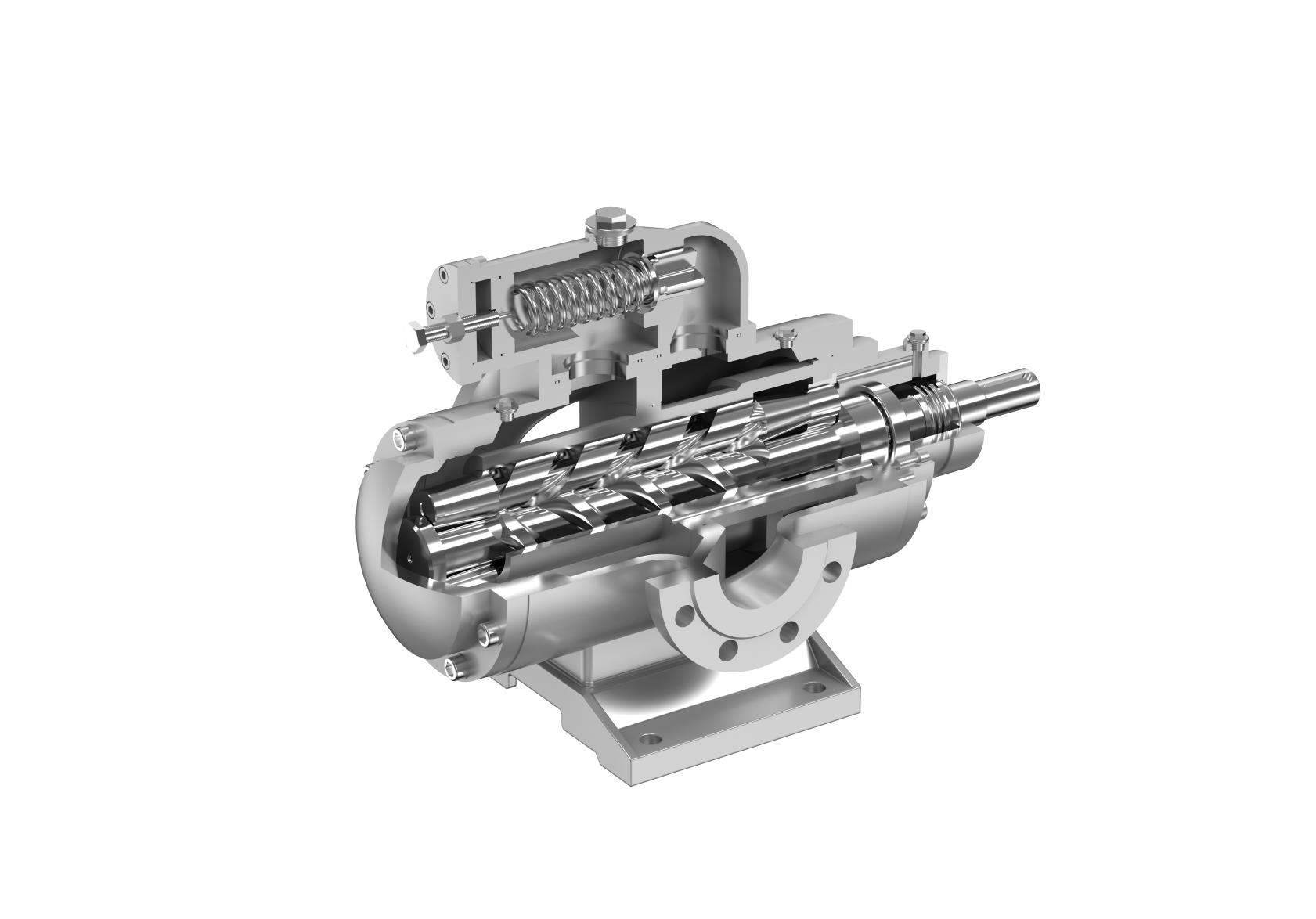
Thanks to its unique structural design, the pump offers remarkable advantages. It features strong self-priming capability with a maximum suction lift of 8 meters and can start without additional priming. It has extremely wide media adaptability, capable of conveying various fluids with viscosities ranging from 1 to 10⁶ mm²/s, including clean fluids, fluids containing micro-particles (diameter ≤ 0.2 mm), and weakly corrosive media. Meanwhile, it operates with low shear force and noise controlled below 75 dB. Equipped with external bearings and an independent lubrication system, it can safely handle non-lubricating media, and its service life is extended by 30% compared with ordinary screw pumps. With these advantages, the twin-screw pump is widely applied in industries such as petroleum and petrochemicals, food processing, marine navigation, and environmental treatment. It can stably convey crude oil, heavy oil, syrup, dairy products, sludge, chemical additives, and other materials. It has a maximum working pressure of 10 MPa and a temperature range of -20℃ to 300℃, enabling it to easily meet various working condition requirements. During operation, regular inspection of screw wear is required; dry running is strictly prohibited, and the solid content of the medium must be controlled within the specified range. For model selection, it is necessary to match the appropriate material and structure based on medium viscosity, temperature, flow rate, and pressure parameters, making it an ideal solution for fluid delivery under complex working conditions.